The review
I. A world that keeps score
Every traditional roguelike makes a promise in its first five minutes, and All Who Wander makes it quietly: nothing here is going to be explained twice. You pick a face from a row of portraits, glance at six attributes — Strength, Fortitude, Agility, Intelligence, Willpower, Personality — and step onto a hex grid lit like a tabletop diorama. Thirty procedurally generated levels lie between you and the end, spread across twelve biomes that run from blinding desert to frozen cavern. There is no grand prologue and very little exposition. The story, such as it is, is the one you write with your mistakes.
That restraint suits it. This is a solo developer’s project, built in the lineage of Pixel Dungeon and the older text-mode games that came before it, and its storytelling happens in the margins: a guild where a stranger will teach you a new discipline, a tavern where a sellsword waits for an offer, a storm rolling across a swamp just as you were about to rest. The store page describes a world that “burns, freezes, grows, and shatters,” and after a dozen runs that line reads less like marketing copy and more like a warning.
II. Turn by turn
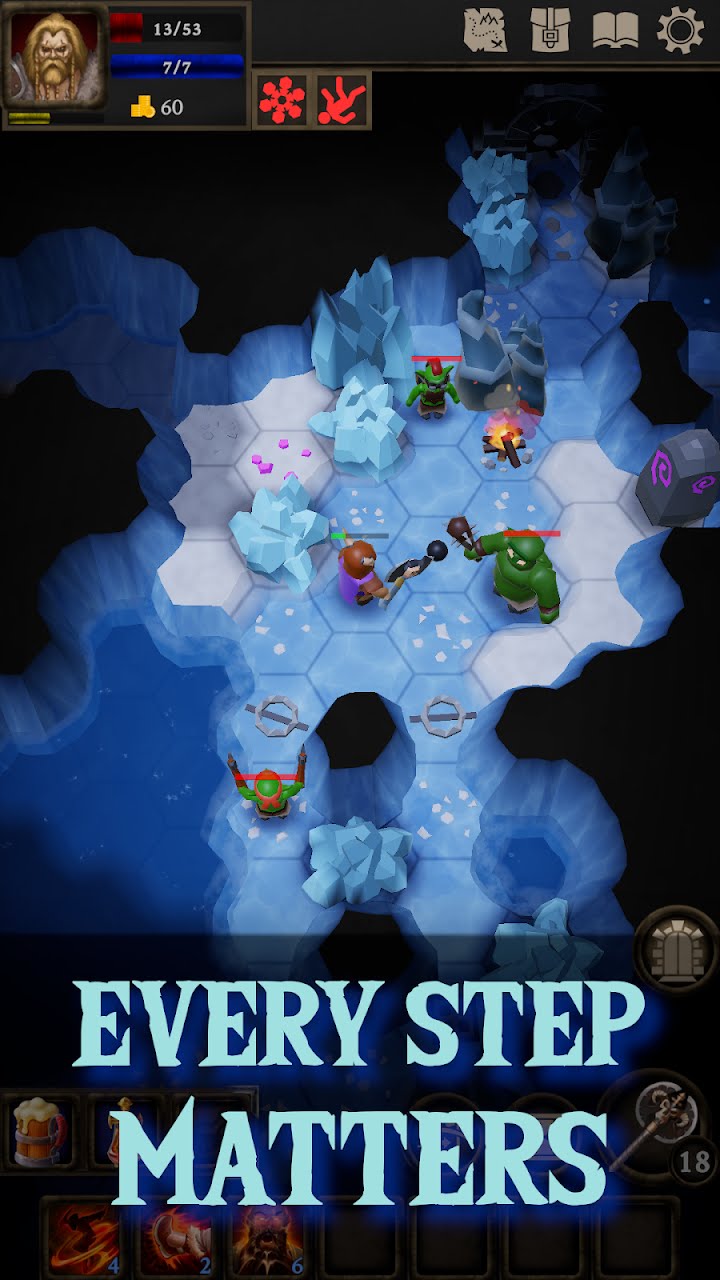
Combat is turn-based and strictly tactical: you move, the world moves. The hex grid is the quiet genius of the design. Six neighbours instead of eight sounds like a small change, but it makes flanking legible and retreat a geometric puzzle, and it turns a doorway or a gap between rocks into a real choke point. Terrain matters more than in most mobile roguelikes. Tall grass hides you; sand dunes drag at your feet; fire spreads into dry brush and turns one careless spell into a blaze that does not care whose side you are on.
Runs are long enough to develop a shape. The early floors teach you the bestiary — more than seventy monsters, plus six bosses — and the middle floors start testing whether your build actually works or only felt good. By the time the frozen caverns arrive, small inefficiencies have become fatal ones. It is a rhythm the genre’s veterans will recognise instantly, and it lands just as well in ten-minute sessions as in a long evening, because the game waits for you between every single move.
Your class is a starting point, not a destiny. The game is happiest when you ignore the label on the box.
III. Builds without borders
The headline number is fifteen character classes, but the more interesting number is ten: the count of skill trees, none of which is fenced off by class. A Ranger, described in-game as “an elusive marksman, skilled with a bow,” can walk into a guild and come out with a grounding in Sorcery — Fireball, Deep Freeze, Ice Shield, and the slow climb towards Ring of Flame and Ice Nova. The store page itself suggests a warrior illusionist or a shaman ranger, and those hybrids are where the game comes alive.
Companions add a second axis. Recruit one from a tavern and your solo crawl becomes a small party, with new abilities and new ways for things to go wrong. More than two hundred items and over a hundred traps, treasures and buildings fill in the rest. What you will not find is meta-progression. Nothing carries over between runs except what you have learned, which is both the purest version of the genre and its hardest sell.
IV. Difficulty, honestly
This is hardcore in the old sense. Permadeath is the default, and the first hours are mostly a sequence of instructive funerals. The game does offer Casual and Adventure modes that switch permadeath off, and we would gently recommend newcomers start there: the systems are deep enough to enjoy with a safety net, and the full-stakes mode will still be waiting. Our main complaint is that the game’s information density can outpace its teaching. Several interactions — how elements meet, how terrain tilts a fight — are learned by dying rather than by reading.
V. Ink, embers and lantern light
The 3D hex boards look like painted tabletop terrain photographed from above. Ice tiles glow a cold cyan, desert plateaus go amber at the edges, swamps crowd in with dark ferns and grey stone, and dungeons are cobwebbed bone-yards lit by the odd torch. Interface panels lean on parchment, timber and wrought iron without becoming fussy, and the skill trees, with their painterly icons, are a pleasure to browse even when you have no points to spend.
We played most of our runs on commutes with the volume low, so our notes on audio are brief: it stays in the background and never undercuts the tension. The visuals are what you will remember — especially the moment a fire you started yourself crosses the screen towards you.
VI. What it costs
The business model deserves its own paragraph because it is refreshingly simple. The free download includes the complete thirty-level adventure with three classes and one boss. A single one-time purchase unlocks the remaining twelve classes and five bosses. There are no ads and no microtransactions, and the whole thing plays offline. On a platform where the genre is too often drained by energy timers and loot boxes, this is exactly the kind of deal worth rewarding.
VII. Verdict
All Who Wander is not the friendliest roguelike on Android, and it does not pretend to be. It is, however, one of the most honest: a clear set of rules, a world that reacts to them, and a build system generous enough that your fortieth run can still surprise you. With a 4.5-star player rating on Google Play and steady updates from its sole developer, it deserves a far larger audience than its 50K+ installs suggest. Bring patience. Leave the lantern lit.
— M.E.